What Really Happened on October 31? A Monk, a Money Box and a Carved Turnip
Half of what gets repeated about this date is myth. The real history is stranger, and it explains why many Bible believers still will not keep Halloween.
 Learn more ›
WITTENBERG, Germany —
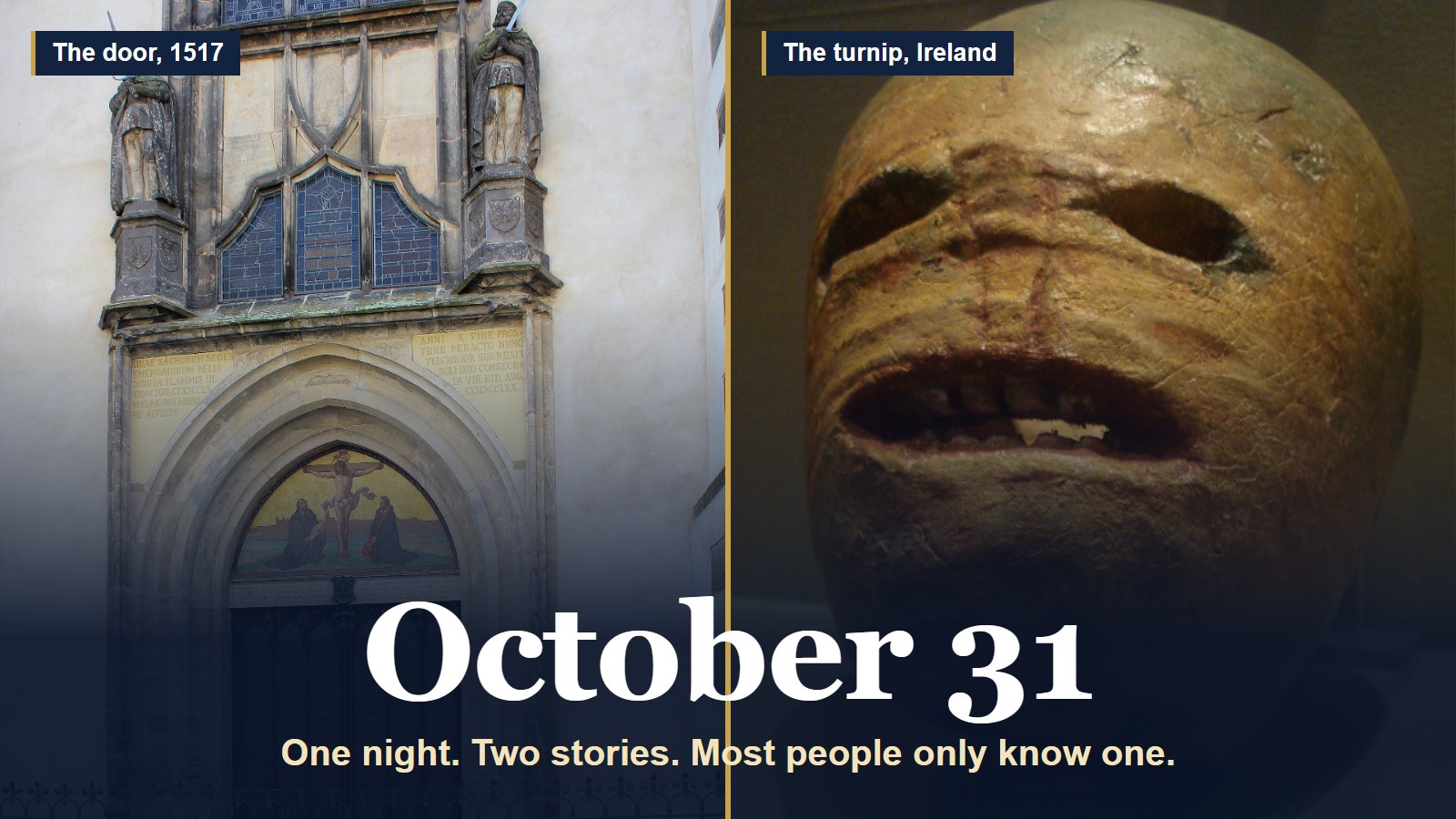
Tonight millions of children will go door to door in costume. Almost none of them will know that this same night, 509 years ago, a German monk and Bible teacher wrote a letter that helped split Western Christianity.
Most of us have heard a version of both stories. There is the monk with a hammer, and the ancient pagans in masks. The trouble is that much of what gets repeated about each one cannot be proven, and some of it is simply wrong.
Here is what the record shows, what it does not, and why it still matters to the church.
The money box that started it all
In 1515 Pope Leo X granted a sweeping indulgence to pay for St. Peter's Basilica in Rome. An indulgence was a church grant promising release from punishment for sin, and it could be bought on behalf of loved ones in purgatory.
In 1517 a preacher named Johann Tetzel worked the towns near Wittenberg. Sales were banned in Wittenberg itself, so people from Luther's town traveled to buy. They came home with their certificates. Luther, their teacher and preacher, had seen enough.
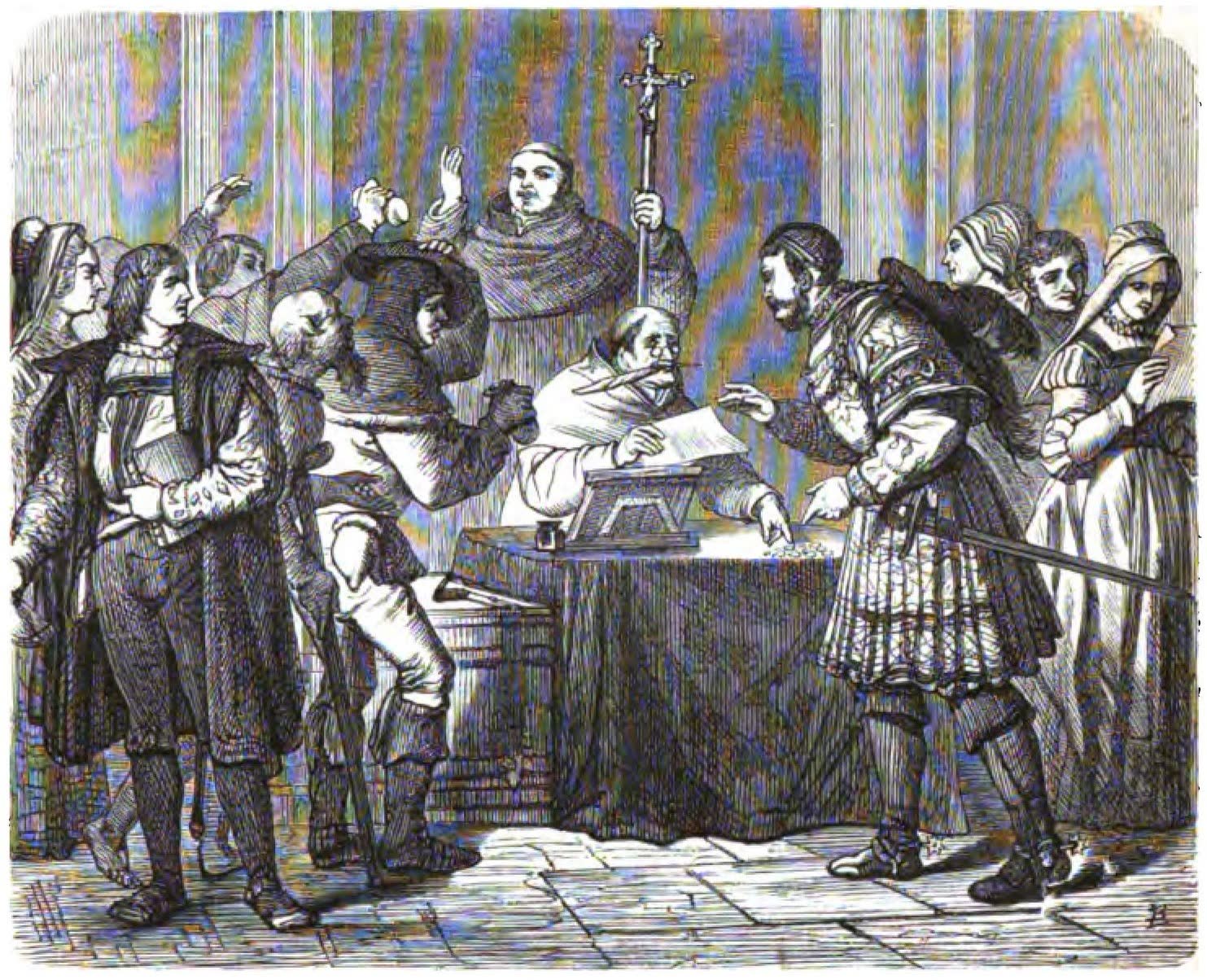
He had already spent years in a monastery, trying to make himself right with God and finding no peace. Studying Romans, he came to see that righteousness is God's gift, received by faith. Then he watched forgiveness being sold. His answer was sharp:
“They preach man who say that so soon as the penny jingles into the money-box, the soul flies out [of purgatory].”
95 Theses, Thesis 27
Why that date? What October 31 meant in 1517
“Halloween” is a Scottish shortening of All Hallows' Even. A “hallow” is a holy one, a saint. October 31 was the vigil of All Saints' Day, and the church's observance began that evening. All Souls' Day, for the dead in purgatory, followed on November 2.
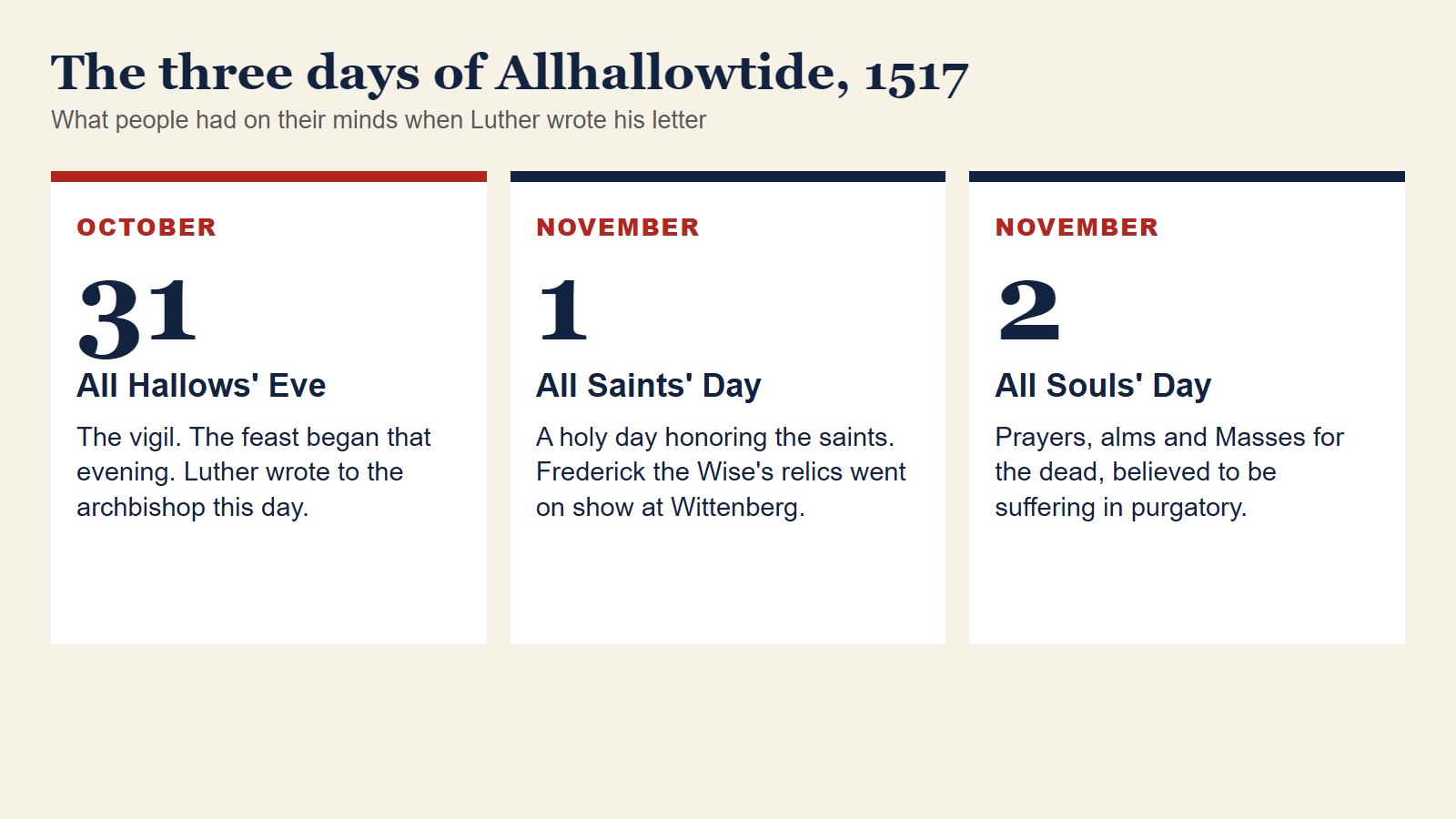
In Wittenberg it was a bigger occasion still. The Castle Church was also All Saints' Church, so this was its own feast. Frederick the Wise kept one of the largest relic collections in Europe there, listed at more than 17,000 items in 1518, and it was shown to the faithful each All Saints' Day.
So people's minds were already on death and purgatory, the same fear the indulgence preachers were working on. Did Luther choose the date for that reason? No one knows. He never explains it. What we know is that he dated his letter to Archbishop Albrecht on that day.
How the date came about
- 609-10A Roman temple rededicatedPope Boniface IV dedicates the Pantheon to Mary and all martyrs on May 13.
- 731-41A chapel in St. Peter'sGregory III dedicates a chapel to all saints. Many link November 1 to this, though sources conflict.
- 800November 1 appearsBy now churches in Ireland and northern England keep an all-saints feast on that day.
- 835An empire adopts itAt Gregory IV's request, Louis the Pious makes it a holy day across his realm.
- c. 1000The dead get their dayOdilo of Cluny sets November 2 for the dead in his monasteries. It spreads through the Western church.
- 1517Luther writesOn the eve of the feast, the 95 Theses go to Archbishop Albrecht.
Did Luther really nail anything to that door?
Maybe. The certain part is the letter, which enclosed the Theses. The hammer comes from his colleague Philip Melanchthon, who mentioned the posting only after Luther's death. Some historians think it happened later, or not at all. Others note that posting on a church door was routine for a university debate, so it would have been no great drama either way.
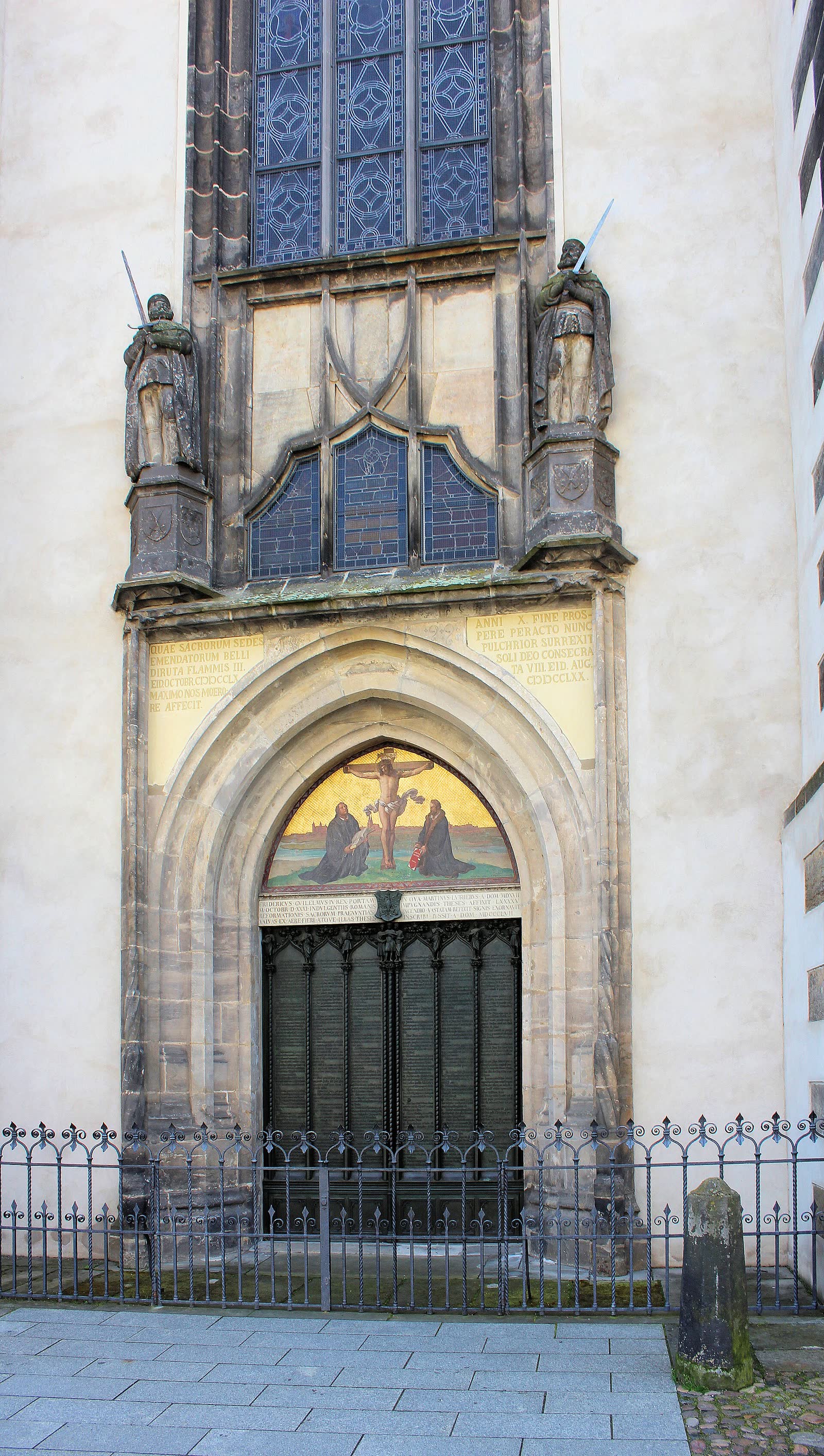
He was not trying to start a new church, either. He wrote in Latin, for scholars, and he addressed the archbishop with respect. But printers got hold of the Theses, German translations spread, and by early 1518 Rome saw him as a threat.
"Here I stand" may not be what he said
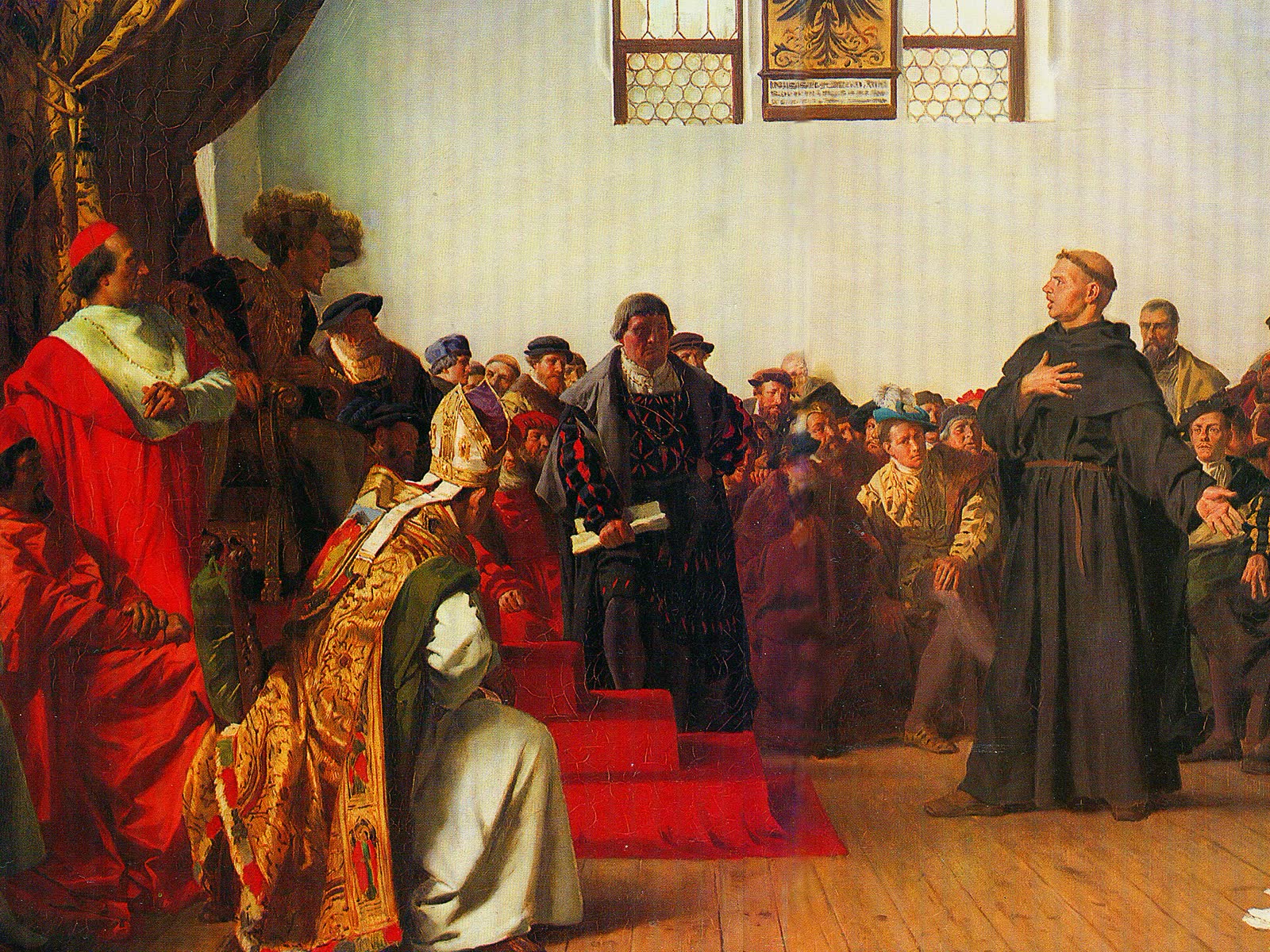
Excommunicated in 1521, he was brought before the Emperor at the Diet of Worms that April and told to take it all back. The famous line is a tradition, not a firm record. What is recorded is, if anything, stronger:
“Unless I am convinced by the testimony of the Scriptures or by clear reason ... I cannot and will not recant anything, since it is neither safe nor right to go against conscience.”
Luther at Worms, April 18, 1521
The 7 Luther sayings that changed everything
Plenty of quotes online are falsely credited to him. These are drawn from his own works, in the translations linked below.
- On what cannot be surrendered. “Of this article nothing can be yielded or surrendered ... even though heaven and earth, and whatever will not abide, should sink to ruin.” (Smalcald Articles, on justification by faith)
- On the moment it opened to him. “All at once I felt that I had been born again and entered into paradise itself through open gates.” (Preface to his Latin Writings, 1545)
- On the Christian life. “Our Lord and Master Jesus Christ, when He said Poenitentiam agite, willed that the whole life of believers should be repentance.” (Thesis 1. The Latin means “repent.”)
- On the church's real riches. “The true treasure of the Church is the Most Holy Gospel of the glory and the grace of God.” (Thesis 62)
- On real faith. “It is impossible that faith ever stop doing good.” (Preface to Romans)
- On idols. “That now, I say, upon which you set your heart and put your trust is properly your god.” (Large Catechism)
- On how it ends. “We are beggars. This is true.” (From his last note, February 1546)
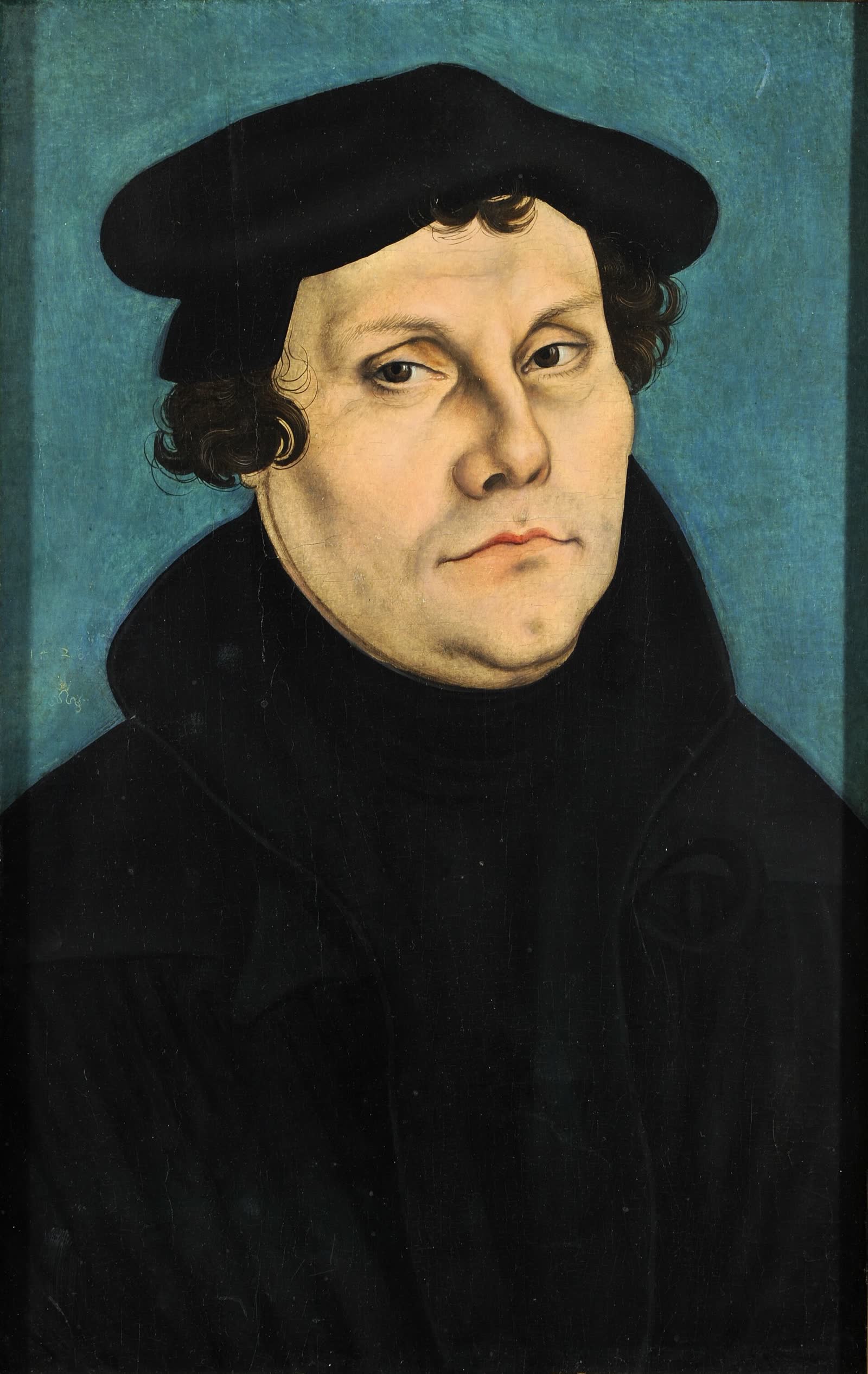
He was no saint to copy in everything. Late in life he wrote On the Jews and Their Lies, a shameful book that later anti-Semites gladly used. Christians should say so plainly. We follow the Christ he pointed to, not the man.
Before the pumpkin, there was a turnip
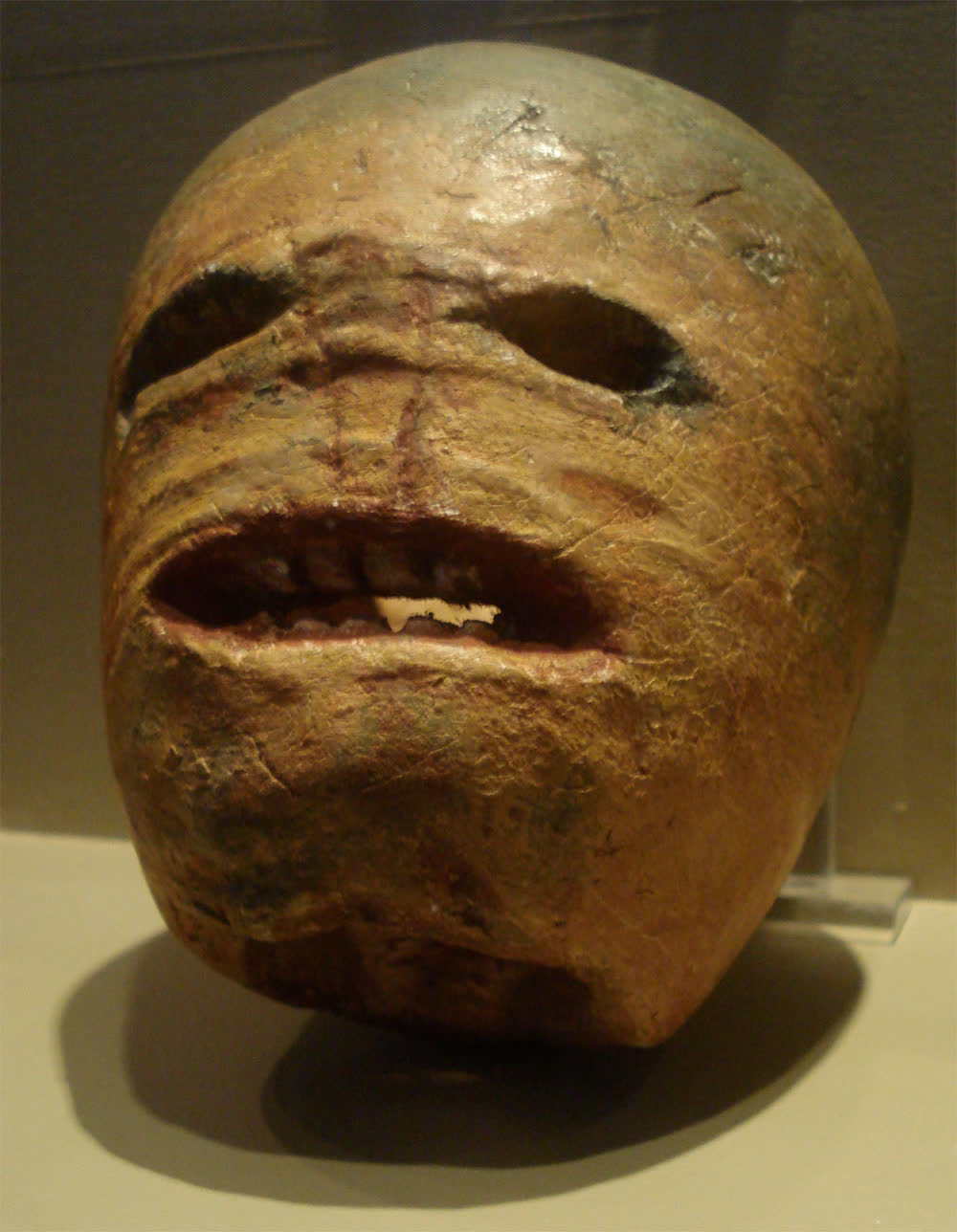
Now to the other story of the night. The lanterns came first in Ireland and Scotland, carved from turnips. Pumpkin carving is an American change, on record by 1837, because a pumpkin is far easier to cut.
Where the customs came from
- CostumesDisguise against spiritsFirst recorded in 1500s Scotland. It was believed to protect people from spirits, or to imitate them.
- LanternsTurnips firstSaid to stand for souls in purgatory or to ward off evil spirits. Pumpkins came with America.
- DoorstepsCakes for prayers"Souling" dates at least to the 1400s. The poor collected soul cakes in exchange for prayers for the dead.
- CandyA modern habit"Trick or treat" first appears in print in 1917, in Ontario, and spreads in the 1930s.
- FiresThe Celtic questionOften called the best case for a Celtic link, but detailed accounts date only from the 1700s and 1800s.
Look at that list closely. It holds folk fear of spirits, Catholic prayers for the dead, and modern American habit. Which raises the bigger question.
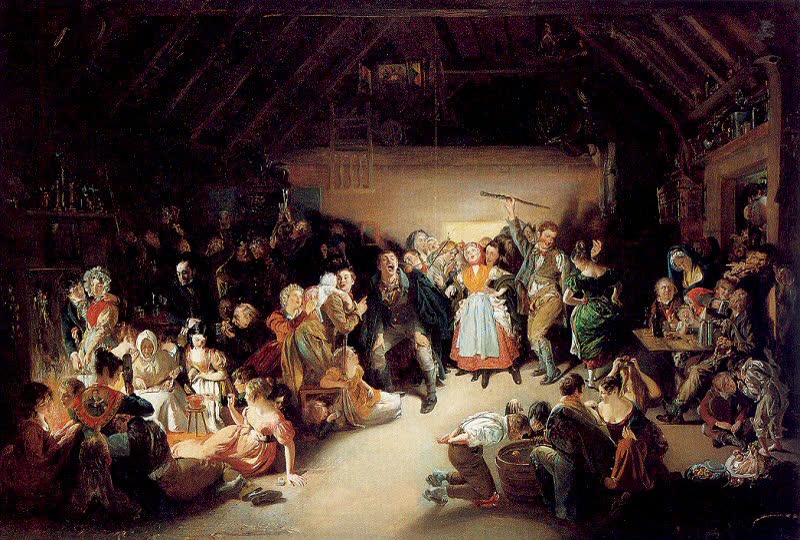
So is Halloween pagan or not? The scholars are split
- The pagan case. Samhain was a real Gaelic festival around November 1, and medieval Irish tales describe the Otherworld opening then. James Frazer argued the church's date was chosen because of it. The weak spot is that the tales were written down by Christian monks, from the 800s on.
- The Christian case. The name and date come from the church, and the feast may have reached November 1 by other routes. Historian Ronald Hutton finds no evidence Samhain began as a festival of the dead. The weak spot is that this does not explain the spirits and divination that gathered around the night.
- The blend. Folklorist Nicholas Rogers holds that most customs grew up alongside the medieval church days, with Samhain contributing little beyond its fire rites. Hutton suggests the Christian feast reinforced Samhain's importance. This is probably the safest ground, though much of the evidence is late.
5 Halloween and Reformation claims to stop repeating
- There was a Celtic god of death named Samhain. Samhain is the name of a festival. The records do not show a god by that name.
- Druids sacrificed people every Samhain. Stories of sacrifice exist in the old tales, but scholars treat them as interpretation, not established fact.
- The church picked November 1 to replace Samhain. It is a theory, and it is disputed.
- Luther said, “If the world ended tomorrow, I would plant an apple tree.” No one has traced it to his writings.
- “Sin boldly” means Luther excused sin. He did write it, in a 1521 letter to Melanchthon, but it is about trusting Christ's grace, and it needs its full context.
Truth does not need help from bad history. A weak claim can undo a strong conviction.
Three ways Christians answer, and where we stand
- Join in. To most people it is only candy and costumes, and a chance to meet the neighbors. Those who hold this view often cite Romans 14:5, and many are sincere believers.
- Redeem or replace it. Hold a harvest party or trunk-or-treat, or keep Reformation Day. The motive is good. The caution is keeping the same night and habits under a new name.
- Abstain. Take no part in a day built around death, fear and the occult. This is where this paper stands, and where many holiness people have long stood.
Our objection does not hang on who is right about Samhain. Here are the reasons that stand either way.
- God does not treat the occult as a game. Deuteronomy 18:10-12 names the witch, the charmer, the consulter with familiar spirits and the necromancer as an abomination to the Lord. What He calls an abomination, we should not dress our children up as.
- We belong to the light. Colossians 1:13 says God “hath delivered us from the power of darkness.” Ephesians 5:11 says, “And have no fellowship with the unfruitful works of darkness, but rather reprove them.”
- Holiness means being separate. 2 Corinthians 6:17 and Romans 12:2 still stand, and “everybody does it” has never been a reason in the Bible.
- The church side of the day is wrong too. Its customs grew up around prayers for souls in purgatory, the very thing the Reformers rejected. Hebrews 9:27 says it is appointed unto men once to die, “but after this the judgment.”
- Others are watching. Paul warned that liberty can “become a stumblingblock to them that are weak.” (1 Corinthians 8:9) Our children learn what we treat as harmless.
Paul also draws a hard line in the same letter: “ye cannot be partakers of the Lord's table, and of the table of devils.” (1 Corinthians 10:21) Standing apart is no license for pride. Christians differ here, and a kind word at the door may do more than a lecture.
From Wittenberg to your pew
This argument is not new. Protestants rejected purgatory in the 1500s, and in New England the Puritans strongly opposed the holiday. The line from that night runs closer than you may think.
Luther's German New Testament came out in 1522. William Tyndale's English New Testament followed in 1526, and the King James translators of 1611 drew heavily on his work. On May 24, 1738, at Aldersgate Street in London, John Wesley heard Luther's Preface to Romans read and felt his heart “strangely warmed.” From Wesley's preaching of holiness came the Holiness movement, the soil of the Pentecostal revival.
That leaves the question Luther's letter raised, the one worth asking while the doorbell rings tonight. What actually saves a soul?
“For there is one God, and one mediator between God and men, the man Christ Jesus.”
1 Timothy 2:5