Four Locked AI Researchers, One Bible, and the End Times
We sealed AI researchers off with the King James Bible and the early church writers and told them to find the truth, not the crowd. Here is where they landed, how sure they were, and what an examiner caught.
 About this photo ›
Why try this at all
Christians have argued about the last things for nineteen centuries. Will the church be caught up before the great tribulation or after it? Is the thousand years of Revelation 20 a future reign on earth, or a picture of the present age? Was much of Jesus' prophecy fulfilled when Rome destroyed Jerusalem in AD 70? Good and godly people have landed in different places.
This experiment asked a narrow question. If careful researchers were cut off from anyone's preferences and asked only to weigh the evidence, where would they land, and how sure would they be? The researchers were AI models, not people. That makes the exercise easier to control, and it also limits what it can prove. Both sides of that are set out below.
How the experiment worked
The experiment in four steps
- Round 1Bible + early writersThree blind researchers studied the return of Christ.
- Round 2Bible onlyNine plain questions. No modern labels anywhere.
- Round 3Bible, writers + the webFind the truth, not the consensus. Commit and give your confidence.
- FinalThe examinerA fourth researcher tested all three, then wrote its own thesis.
Every AI researcher ran as a separate session in a brand-new, empty folder. It could read files only in that folder and in a fixed library. It had no shell, no ability to write or change files, no saved memory, no project instructions, and no connectors to other services. It was given its own short instructions, which contained no one's views on the end times. Before round 3, a sandbox test confirmed what each session could see: the tools, its instructions, and an account email address, but no memory files, no earlier results and no personal preferences.
The library held the King James Bible (the standard 1769 text, one file per book) and seventeen Christian works written before AD 1000. These ran from the Didache (around AD 100) through Justin Martyr, Irenaeus, Hippolytus, Tertullian, Cyprian, Victorinus, Lactantius and Cyril of Jerusalem to Augustine's City of God Book 20 and Jerome's Commentary on Daniel (around AD 407), all in public-domain translations.
Round 1 gave three blind researchers the KJV and the early writers and asked about the return of Christ: its timing, the gathering, the Antichrist, the millennium, and whether anything must come first. Each report was checked by a computer and by a separate AI checker, then compared.
Round 2 removed everything but the Bible. Three researchers answered nine plain questions with no modern labels anywhere in the prompts (“pre-tribulation”, “amillennial” and the like were left out on purpose), and one researcher ran on a different model.
Round 3, the main subject here, opened the doors. Each of three researchers kept the library but could also search the web and open web pages, for non-fiction only (novels and films such as the Left Behind series were excluded). Each was told that the purpose was not to report what people think or to find a consensus, but to find the most likely truth of what the Bible teaches. Scripture was named as the final authority. Each had to weigh the strongest case of every major school, commit to a view, give a confidence level for each conclusion, and answer the best objections. Researchers 1 and 2 ran on Claude Opus 5.5; researcher 3 ran on the smaller Claude Sonnet 5.5.
Quote checking. After every round, a computer program checked every quotation word for word against the library and confirmed that the reference matched (within one verse). Web addresses were tested to see whether they still load. A separate comparer, locked to reading only the theses and the checks, set out where the researchers agreed and disagreed. In round 3 the program checked about 446 quotations. Apart from one slip in wording (a changed verb form in 2 Thessalonians 2:8) and three loose references, the Scripture quotations were exact.
The reading catalog. Afterward, every tool call each round-3 researcher made was pulled from its session record: every verse it looked up, every section of the early writers it opened, every web page it fetched and every search it ran. That catalog matters, because it shows the difference between a source a researcher actually read and a source it only saw named in a search result.
A fourth researcher. Finally, a fresh, equally locked researcher was given the three theses, the comparison and the reading catalog, with the library. Its web access was limited by instruction to checking claims the three had relied on. Its job was to test every argument against the KJV text and the cited sources, find errors and overreach, and then write its own thesis.
The honest limits
- These are machines, not prophets or pastors. An AI model has read an enormous amount of Christian writing during its training, so it does not come to Scripture as a blank slate. Locking the session keeps out a reader's preferences. It cannot remove what the model already absorbed.
- The researchers are not fully independent. All of them are Claude models from one company, Anthropic. Researchers 1, 2, 4 and 5 ran on Claude Opus 5.5; researcher 3 ran on Claude Sonnet 5.5. The three round-3 researchers leaned on many of the same web sources. Their agreement is weaker evidence than the agreement of three scholars from different traditions would be. For that reason, a model from a different company was later given the same assignment (see “A second opinion from Google” below).
- Most web sources were seen, not read. The catalog shows that of the 127 outside web addresses the three theses cite (not counting online copies of the library texts), only 11 were actually opened. The rest were known from search-result summaries.
Outside web sources cited in round 3
11 actually opened and read116 known only from search-result summaries
Counted from the researchers' own session records, not from their reports. Online copies of the library texts are not included.
- A quote check proves wording, not meaning. It can show that a verse was copied exactly. It cannot show that the verse was read rightly.
- The prompt set the frame. It listed the schools to be weighed and asked for a commitment. A different question might have drawn different emphases.
- This is an experiment, not a creed. Nothing here is offered as the doctrine of this publication or of any church.
What the three round-3 researchers concluded
Working separately, the three reached the same overall position. In the usual labels it is futurist, historic (not dispensational) premillennial and post-tribulational, with a partial-preterist reading of AD 70. In plain words:
- Christ will return once more, personally, bodily and visibly. “This same Jesus, which is taken up from you into heaven, shall so come in like manner as ye have seen him go into heaven.” (Acts 1:11)
- A final apostasy and a personal “man of sin” come first, then a short, unequalled tribulation that falls on the saints.
- The resurrection of the righteous and the gathering of believers happen at that one coming, after the tribulation, not in a separate removal years earlier.
- The Jewish people, hardened in part, will turn to Christ as a people at His appearing.
- Christ will reign with His risen saints on this earth for the age Revelation calls a thousand years, followed by a last rebellion, the judgment of the rest of the dead, and a renewed (not annihilated) creation.
- Rome's destruction of Jerusalem in AD 70 truly fulfilled the near part of Jesus' prophecy, but it was not the Second Coming.
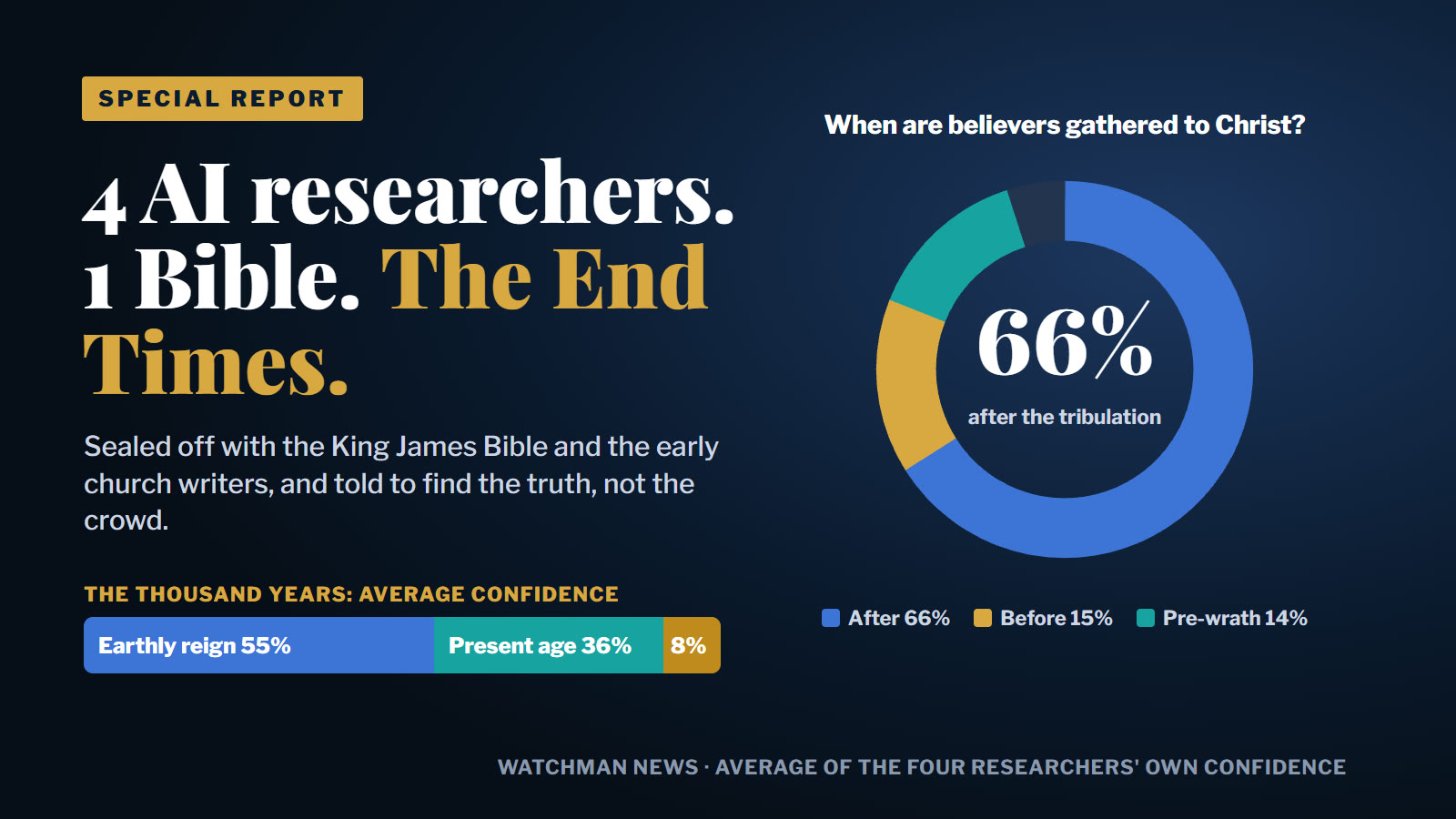
When are believers gathered to Christ?
After the tribulationBefore the tribulation"Pre-wrath"
Each researcher's own confidence. Researcher 3's 55% is its own view (one coming, saints delivered from wrath); it rated a gathering after the tribulation, in some form, at 73%.
Thesis 1: "The Kingdom Comes with the King"
Researcher 1 rested its case on Paul's own order of events. “Now we beseech you, brethren, by the coming of our Lord Jesus Christ, and by our gathering together unto him,” (2 Thessalonians 2:1) is followed two verses later by the warning that the day will not come “except there come a falling away first, and that man of sin be revealed” (2 Thessalonians 2:3). It argued that Paul's trumpet “at the last trump” (1 Corinthians 15:52) and the trumpet of Matthew 24:31, which follows “Immediately after the tribulation of those days” (Matthew 24:29), belong to one event. It also pointed to Revelation 16:15, where Christ is still saying “Behold, I come as a thief” late in the bowl judgments. It accepted the strongest part of the partial-preterist case: Luke 21:20-24 describes the siege of AD 70. It admitted that “immediately after” in Matthew 24:29 was the hardest point for its view. It rated premillennialism about 60%, amillennialism about 30% and postmillennialism about 8%.
Thesis 2: "The Last Things"
Researcher 2 reached the same order of events and argued it at the greatest length. It gave the clearest treatment of Revelation 20. The same verb is used for the martyrs who “lived and reigned with Christ a thousand years” (Revelation 20:4) and for “the rest of the dead” who “lived not again until the thousand years were finished” (Revelation 20:5). It argued that nothing in the passage signals a switch from a spiritual to a bodily meaning, while setting out the opposing argument from John 5:25-29 fairly. It also noted, alone among the three, that the “are” in Revelation 20:10 is a word the KJV translators supplied, so it is only modest evidence. It rated the gathering after the tribulation at 70% and premillennialism at 62%.
Thesis 3: "A Full Eschatological Thesis"
Researcher 3 ran on the smaller model (Claude Sonnet 5.5) and took the most literal line. It built a future seven-year “seventieth week” of Daniel 9:27 into its order of events (60%), held to an exact thousand years (65%, assuming premillennialism) and a literal rebuilt temple (60%). It leaned toward the “pre-wrath” view of the gathering, rating its own position only 55%. It was the most candid about its sources, saying it “could not read” several major commentators directly. The comparer found its weakest points: the literal-temple argument assumes the very reading of Daniel 9:27 that is in dispute, and the thesis never dealt with Revelation 16:15 although it places the bowls of wrath after the gathering.
Where the three agreed most firmly
- 2 Thessalonians 2:1-8 against a separate gathering before the man of sin appears.
- 2 Timothy 2:18 against full preterism: “Who concerning the truth have erred, saying that the resurrection is past already; and overthrow the faith of some.” The resurrection is bodily, and death has not yet been destroyed.
- Luke 21:24 as the gap between AD 70 and the end: “Jerusalem shall be trodden down of the Gentiles, until the times of the Gentiles be fulfilled.”
- No date can be known. “But of that day and hour knoweth no man, no, not the angels of heaven, but my Father only.” (Matthew 24:36)
Where they disagreed
- How the gathering relates to God's wrath. Theses 1 and 2 put the gathering at the very end. Thesis 3 left room for an interval before the last battle.
- Daniel's seventieth week. A future seven-year period was 35% for theses 1 and 2 and 60% for thesis 3.
- The thousand years and the temple. Exactly 1,000 years: 35%, 35%, 65%. A literal Jerusalem temple in 2 Thessalonians 2:4: open, 45%, 60%.
- “This generation” (Matthew 24:34). Theses 1 and 2 read it as Jesus' contemporaries, with “all these things” meaning the signs (55% in thesis 2). Thesis 3 gave a compound reading only 45%.
- Nearness. Theses 1 and 2 said the final crisis could unfold within a few years once it begins. Thesis 3 declined to estimate.
The fourth researcher: an examiner
The fourth researcher began with no stake in any of the three theses. It re-read the key passages itself, checked the weight-bearing quotations from the early writers against the library, and used the reading catalog to find claims built on sources nobody had opened. It made 23 web calls, all aimed at checking specific claims.
Where it found the three on firm ground. It judged these arguments to survive examination:
- 2 Thessalonians 1:6-10 and 2:1-8, which tie one coming to the end of the persecution and the destruction of the man of sin. The persecuted are given rest “when the Lord Jesus shall be revealed from heaven with his mighty angels,” (2 Thessalonians 1:7).
- 2 Timothy 2:18 together with the bodily resurrection, against full preterism.
- Luke 21:20-24 as a real fulfilment in AD 70, with “the times of the Gentiles” between it and the end.
- The shared trumpet, angels, gathering and clouds of Matthew 24:30-31, 1 Thessalonians 4:16-17 and 1 Corinthians 15:52.
- Romans 11 on a future for ethnic Israel.
- 2 Peter 3:6 and the flood comparison, for a renewed creation.
- Zechariah 14:16-19 and the double “lived” of Revelation 20:4-5 as the best evidence for an earthly reign after the coming, “real but not decisive.”
It also found every Scripture quotation it checked to be accurate, and confirmed Josephus's figures and most of the patristic quotations.
What it found wrong or overstated. The most important findings:
- An early writer misreported. Theses 1 and 3 listed Victorinus among those who taught an earthly thousand-year reign. The library text they had in front of them says the opposite: “Those years wherein Satan is bound are in the first advent of Christ”. The examiner explained why. The surviving Latin text was revised by Jerome, who removed Victorinus's original millennialism, as a standard church encyclopedia notes. So the claim may be true of the original Victorinus, but not of the text the researchers cited.
- Augustine's reasons. Two theses said Augustine gave up the millennial view mainly because of crude, fleshly versions of it. In City of God 20.7 he does not say why he changed his mind, and the reasons he goes on to give are from Scripture. Those reasons went unanswered.
- Verses stretched past their context. Theses 1 and 2 used “one day is with the Lord as a thousand years” (2 Peter 3:8) to make the day of judgment span a thousand years. Peter's point is God's patience in the delay: “The Lord is not slack concerning his promise, as some men count slackness; but is longsuffering to us-ward” (2 Peter 3:9). Theses 1 and 2 also read “all the saints” in Zechariah 14:5 as risen believers, although the Hebrew “holy ones” often means angels, as in “a watcher and an holy one came down from heaven;” (Daniel 4:13).
- A tension inside the “this generation” argument. Theses 1 and 2 said “all these things” in Matthew 24:34 means the signs, yet they put the cosmic signs at the very end. Luke's account, after the sun, moon and stars, says “This generation shall not pass away, till all be fulfilled” (Luke 21:32). The examiner judged that Matthew's own repeated phrase about Jerusalem (“All these things shall come upon this generation”, Matthew 23:36) is the stronger argument, and that none of the three used it.
- Texts that were not faced. On the millennium, the examiner said the three never tested Revelation 20 against Paul's timing. “The last enemy that shall be destroyed is death.” (1 Corinthians 15:26), and Paul says when: “So when this corruptible shall have put on incorruption, and this mortal shall have put on immortality, then shall be brought to pass the saying that is written, Death is swallowed up in victory.” (1 Corinthians 15:54), at the resurrection of “they that are Christ's at his coming” (1 Corinthians 15:23). They also missed that John's description of the eternal state draws on the same chapter of Isaiah that they used for the millennium. On the gathering, none of the three discussed the best pre-tribulation text in the Gospels: “I will come again, and receive you unto myself; that where I am, there ye may be also.” (John 14:3).
- The three-and-a-half years. All three assumed a literal future period of about three and a half years. None of them weighed Revelation 12:5-6, where the woman's 1,260 days follow directly after her child “was caught up unto God, and to his throne.” (Revelation 12:5).
- Confidence running ahead of evidence. Thesis 3 rated the future seven-year week, the exact thousand years, the literal temple and a personal Antichrist higher than its evidence supported. It also cited Joel 2:31 against the pre-wrath view when that verse's order is the pre-wrath view's own.
The fourth thesis
Having examined the three, the fourth researcher wrote its own thesis, and it did not simply side with them.
On most points it agreed:
- one future, personal, bodily and visible return;
- full preterism is false;
- AD 70 was a real but partial fulfilment;
- the gathering comes at one coming after the tribulation, not before it (70%);
- a final apostasy and a personal man of sin destroyed at the coming (75%);
- a future turning of the Jewish people to Christ (70%);
- a renewed creation (80%);
- no date can be known.
It parted from the three on the millennium. Weighing Paul's timing in 1 Corinthians 15, Romans 8:19-23, 2 Peter 3:10-13 and the repeating structure of Revelation, it judged it slightly more likely that the “thousand years” of Revelation 20 is the present age seen from heaven's side. On that reading, Satan is restrained from deceiving the nations while the gospel goes out, and the faithful dead “lived and reigned with Christ a thousand years” (Revelation 20:4) in the presence of the Lord. It ended the age in a short final crisis, a single return, one general resurrection of the just and the unjust, one judgment, and the new heavens and new earth.
It held that view at only 50%, against 40% for an earthly reign after the coming and 10% for postmillennialism. It named its weakest point plainly: Zechariah 14:17-19, where nations are punished after the Lord's feet stand on the Mount of Olives, is hard to fit into its view. It also read the 1,260 days and 42 months of Revelation mainly as symbols of the whole age between the ascension and the return (55%), with a literal final three and a half years possible (30%).
The thousand years of Revelation 20
Earthly reign after the comingThe present agePostmillennial
The examiner was the only one to lean away from an earthly reign after the coming.
In other words, the examiner confirmed what the three agreed on about the coming and the gathering, and it reopened the question they were least sure of.
Round 5: every source read
Because so few web sources had been opened, a fifth researcher (Claude Opus 5.5, locked the same way) was given one job: open every outside source the four theses cite, 121 in all, and read the whole early-church library, then check each claim against what the source actually says. It opened 74 in full and 31 in part (mostly paywalled articles); 16 would not load.
The main conclusions held: one personal, visible return; full preterism is false; AD 70 fulfilled the near part of the prophecy; the gathering comes after the tribulation (about 70%); and a future turning of Israel. Of the 99 sources the earlier researchers knew only from search results, 41 supported the claim drawn from them, 23 partly did, 3 did not, and 3 argued the opposite.
But several numbers came down. It put an earthly thousand-year reign at about 52%, not 60%, because sources the theses cited held the strongest arguments against it and those arguments went unanswered. It also judged that the examiner's 50% lean the other way was not earned: the Didache and Papias cut against it, and every early writer in the library, including Augustine and Jerome, reads the three and a half years as a final period. Thesis 3's highest numbers fell furthest (seven-year week 60% to 30%, exact thousand years 65% to 35%, literal temple 60% to 35%), and in two cases its own sources argued the opposite.
Its chief finding was a pattern: the sources were mostly described correctly, but the arguments in them that cut against a thesis were too often left out. The charts below show the researchers' original ratings.
A second opinion from Google
Because every researcher above was a Claude model from Anthropic, one more check was run on a model from a different company: Google's Gemini, using the model Gemini lists as “Argon” at its highest thinking setting. It ran in a temporary chat with no saved memory or personal settings, was given the same assignment as round 3, and was not shown any of the Claude results. Unlike the Claude researchers, it was not locked to the library; it searched the web on its own.
It reached the same overall position: one personal, bodily and visible return (99%); full preterism false (99%); AD 70 a real but partial fulfilment (92%); the gathering of believers at that one coming, after the tribulation (85%); a personal man of sin destroyed at His appearing (85%); a future turning of the Jewish people to Christ (78%); and this creation renewed rather than destroyed and replaced (92%). On the millennium it also landed close to the Claude researchers: an earthly reign after the coming at 55%, against 38% for the view that the thousand years is the present age.
Where it differed, it leaned further in the direction the fifth researcher had moved. It put a future seven-year week at 20%, an exact 1,000 years at 18% and a literal rebuilt temple at 25%, and it judged Daniel's seventieth week to have been fulfilled in the first century (80%).
One limit should be stated plainly. Gemini twice began a full thesis and then withdrew it before finishing, so only its summary statement and its confidence tables were kept, and its work was not quote-checked the way the Claude researchers' was. It is a second opinion, not a fifth round.
Confidence at a glance
The researchers gave their own confidence for each conclusion. Each dot below is one researcher. Dots far to the right mean “very sure”; dots near the middle mean “could go either way.”
How sure were they?
Researcher 1Researcher 2Researcher 3 (smaller model)The examiner
See the exact numbers
| R1 | R2 | R3 | Examiner | |
|---|---|---|---|---|
| Christ returns personally, bodily, visibly | 99% | 98% | 99% | 97% |
| Full preterism is false | 97% | 97% | 97% | 96% |
| AD 70 fulfilled Luke 21:20-24 and Daniel 9:26 | 90% | 85% | 85% | 90% |
| Gathering after the tribulation, at one coming | 70% | 70% | 55% | 70% |
| Pre-tribulation gathering | 15% | 12% | 17% | 14% |
| Pre-wrath gathering | 12% | 13% | 18% | 12% |
| A future personal man of sin | 75% | 75% | 85% | 75% |
| Future turning of ethnic Israel | 78% | 80% | 72% | 70% |
| Territorial restoration of Israel | 45% | 55% | 55% | 35% |
| Earthly reign after the coming (premillennial) | 60% | 62% | 58% | 40% |
| Present-age millennium (amillennial) | 30% | 30% | 33% | 50% |
| Postmillennial | 8% | 8% | 7% | 10% |
| "Thousand years" means exactly 1,000 | 35% | 35% | 65% | – |
| A future seven-year seventieth week | 35% | 35% | 60% | 25% |
| A final period of about 3½ years | 55% | 55% | 55% | 30% |
| Literal Jerusalem temple in 2 Thessalonians 2:4 | – | 45% | 60% | 30% |
| New creation renews this world | 80% | 75% | 70% | 80% |
| Revelation written under Domitian (c. AD 95) | 65% | 70% | 70% | 70% |
| The date of His return can be known | 1% | 0% | 1% | 0% |
A missing dot means that researcher gave no number.
*Thesis 3's own view (one visible coming, with the saints delivered from wrath); it rated a gathering after the tribulation, in some form, at 73%.
What Scripture does not tell us
Every researcher, including the examiner, listed questions the text leaves open. Some of them are the very questions people argue about most:
- The day and the hour. “It is not for you to know the times or the seasons, which the Father hath put in his own power.” (Acts 1:7). None of the four would estimate how near or far the return is.
- Who or what restrains the man of sin (2 Thessalonians 2:6-7). Augustine admitted he did not know, and all four followed him.
- Whether “the temple of God” in 2 Thessalonians 2:4 is a rebuilt building or something else.
- Whether Revelation's numbers are calendar figures or symbols: the 1,260 days, the 42 months, the thousand years, the 144,000, and Daniel's 1,290 and 1,335 days.
- How to fit “Immediately after” (Matthew 24:29) together with “This generation shall not pass” (Matthew 24:34). All four called this unresolved.
- What Ezekiel's temple (Ezekiel 40-48) describes, and whether any modern event fulfils prophecy about the land.
Moses drew the line long ago: “The secret things belong unto the LORD our God: but those things which are revealed belong unto us and to our children for ever, that we may do all the words of this law.” (Deuteronomy 29:29).
Sources consulted tap to open
This list is drawn from the reading catalog, which was built from the researchers' own session records rather than from their reports. “R1” to “R3” mark which round-3 researcher used a source. The full catalog, with every verse, section, search and web page, is kept with the study files.
Scripture (King James Version, 1769 standard text). Every Scripture quotation came from the library files. All three researchers read at least part of 69 chapters, including Daniel 2, 7, 9, 11 and 12; Matthew 24-25; Mark 13; Luke 17 and 21; John 5, 6 and 14; Acts 1 and 3; Romans 8 and 11; 1 Corinthians 15; all of 1 and 2 Thessalonians; 2 Peter 3; Zechariah 12-14; Ezekiel 36-39; Joel 2-3; Isaiah 2, 11, 24-26 and 65-66; and Revelation 1, 3, 5-7 and 11-22. Researcher 2 read Daniel whole; researcher 3 read Daniel 2-12, Revelation 5-22, and 1 and 2 Thessalonians whole. Counting every verse returned to them, the three saw 644, 1,015 and 1,376 verses respectively.
Early church writers (library, public-domain translations from the Ante-Nicene and Nicene Fathers series).
- Didache, c. AD 100: chapter 16, on the world-deceiver, the trumpet and the resurrection (R1, R2, R3; R2 read the whole work).
- Papias, c. AD 125: Fragment 6, on the thousand years (R1, R3).
- Justin Martyr, Dialogue with Trypho, c. AD 155-160: chapters 80-82, on the thousand years in Jerusalem and Justin's admission that “many who belong to the pure and pious faith, and are true Christians, think otherwise” (R1, R2, R3).
- Irenaeus, Against Heresies Book 5, c. AD 180: chapters 25-36, especially 28-30 (the Antichrist's three years and six months, the date of Revelation “towards the end of Domitian's reign”) and 35 (R1, R2, R3).
- Hippolytus, On Christ and Antichrist, c. AD 200: sections 5-6, 16-30, 51-66, especially 59-61 on the church fleeing during the tyrant's reign (R1, R3). On Daniel, c. AD 204: the sections on the last week, Elijah and Enoch (R1, R2).
- Tertullian, Against Marcion 3.24 (R1, R2, R3) and On the Resurrection of the Flesh, chapter 24 and others, on the “Roman state” as the restraint (R2).
- Cyprian, Epistle 55, sections 1, 2 and 7 (R1).
- Victorinus of Pettau, Commentary on the Apocalypse, c. AD 260-304: his notes on Revelation 8 (the visions repeat), 10-11, 17 (Domitian and Nero) and 20 (R1, R2, R3).
- Lactantius, Divine Institutes Book 7, chapter 14, on the six-thousand-year scheme (R2, R3).
- Cyril of Jerusalem, Catechetical Lecture 15, c. AD 350, on the Antichrist and the temple (R1, R2, R3).
- Jerome, Commentary on Daniel, c. AD 407 (Archer's 1958 English translation): his notes on Daniel 7, 8, 9, 11:21-45 and 12, especially Antiochus as a “type” of the Antichrist (R1, R2, R3).
- Augustine, City of God Book 20, c. AD 425: chapters 6-9 on the first resurrection and the binding of Satan, and chapter 19, where he admits he does not know what Paul meant by the restrainer (R1, R2, R3).
Ancient history (web). Josephus, Jewish War Book 6, Whiston translation: 6.6.1 (the Roman standards in the temple court) and 6.9.3 (97,000 captives; 1,100,000 dead, a figure researcher 2 judged probably inflated), opened on CCEL by R1; 6.288-300 (the portents before the fall) opened on Lexundria by R3. Eusebius, Church History 3.5.3 (the flight to Pella) was known only from search results (R1, R2).
Historic and Reformed writers. Herman Bavinck, Reformed Dogmatics 4:687, on Matthew 24:34, read through a blog summary that quotes him (R1). Henry Alford's 1861 argument on the two resurrections of Revelation 20 was known only from search summaries (R1, R2; R1's attempt to open the Wikipedia page failed). Chrysostom's homily on 2 Thessalonians 2 was cited by R3, but its attempt to open it reached the wrong page.
Modern writers, pages actually opened.
- Amillennial: Sam Storms, “Revelation 20:1-15, Part II” (R1, R2); R. Fowler White, “Reexamining the Evidence for Recapitulation in Rev 20:1-10” (R1, R2); Kim Riddlebarger on Zechariah 14 (R1); Cornelis Venema, “Evaluating Premillennialism” (R2).
- Pretribulational: H. Wayne House, “A Defense of the Rapture in 2 Thessalonians 2:3” (R1); Thomas Ice, “The Rapture in 2 Thessalonians 2:3” (R3).
Modern writers known only from search results (titles and summaries seen, pages not opened). These include, from several schools:
- Pretribulational: Hitchcock, Woods, Zuber, Townsend, Walvoord, and Demy and Ice on Pseudo-Ephraem.
- Amillennial and Reformed: Kline, Beale, Merkle, Hoekema (as summarized by others), and the Ligonier and Christ Over All articles.
- Postmillennial and partial-preterist: Gentry.
- Historic premillennial and multi-view: Blaising, Three Views on the Rapture, and Moo, Feinberg and Archer.
- Academic: Cosby on apantēsis, Wolters on 2 Peter 3:10, Dixon on the restrainer, Adams on the Son of Man.
- Historicist (Adventist): Adventist Biblical Research.
Reference works. Bible Hub's Greek lexicon entries (genea, naos), SIL translator's notes on 2 Peter 3:10, and Wikipedia articles on Alford's Law, the day-year principle, textual variants in Revelation and Margaret MacDonald, all known from search results.
The fourth researcher's own checks. It opened six pages to verify claims: the Schaff-Herzog encyclopedia entry on Victorinus; Josephus's preface and Jewish War 6.9.3; Chrysostom's fourth homily on 2 Thessalonians at New Advent; and the abstract of G. K. Beale's article on Isaiah 65:20. Its attempt to reopen the Bavinck page failed. Its 17 searches checked lexicon entries (apostasia, anastasis, paralambanō, enistēmi), the Cosby-Gundry exchange, the 2 Peter 3:10 manuscript reading, the Romans 11:31 variant, the dating of Pseudo-Ephraem, and the debate over the flight to Pella.
"Watch ye therefore"
What should a reader take from all this? Not a new creed, and not a verdict handed down by a machine. Four locked researchers, checked word by word, agreed on a good deal: Christ is coming again, visibly and in the body; the dead will be raised; the date is hidden; and the church is not told to calculate it but to be ready. Where they parted, they parted over the same passages Christians have weighed for centuries, and they said so with numbers rather than slogans.
The best use of an experiment like this is the one the Bereans made of the apostle Paul. They “received the word with all readiness of mind, and searched the scriptures daily, whether those things were so.” (Acts 17:11). The verses are all cited above. Read them in order, read them in context, and weigh them yourself. “Prove all things; hold fast that which is good.” (1 Thessalonians 5:21).
The Lord who gave the Olivet prophecy did not end it with a chart. He ended it with a charge:
“Watch ye therefore: for ye know not when the master of the house cometh, at even, or at midnight, or at the cockcrowing, or in the morning:”
Mark 13:35, KJV
“And what I say unto you I say unto all, Watch.”
Mark 13:37, KJV